2026 Update from the NCSU Strawberry Breeding Program
Yield data at CCRS 2026.
|
Genotype |
Average Berry Wt. (grams) |
Average Yield.Plant (lbs) |
Average Yield Acre (lbs) |
Average Mkt.Plant (lbs) |
Average Mkt Acre (lbs) |
|---|---|---|---|---|---|
|
Camarosa |
22.6 |
1.1 |
18713 |
0.8 |
14557 |
|
Chandler |
24.3 |
1.3 |
23454 |
1 |
18123 |
|
Galletta |
19.8 |
1 |
18225 |
0.7 |
12532 |
|
Liz |
20.1 |
1.1 |
19947 |
0.8 |
13969 |
|
NC 22-005 |
17.4 |
0.9 |
15999 |
0.7 |
11483 |
|
NC 22-011 |
19.4 |
1 |
18059 |
0.8 |
13623 |
|
Rocco |
19.8 |
0.8 |
14704 |
0.6 |
11366 |
|
Genotype |
Average Berry Wt. (grams) |
Average Yield.Plant (lbs) |
Average Yield Acre (lbs) |
Average Mkt.Plant (lbs) |
Average Mkt Acre (lbs) |
|
Camarosa |
22.6 |
1.1 |
18713 |
0.8 |
14557 |
|
Chandler |
24.3 |
1.3 |
23454 |
1 |
18123 |
|
Galletta |
19.8 |
1 |
18225 |
0.7 |
12532 |
|
Liz |
20.1 |
1.1 |
19947 |
0.8 |
13969 |
|
NC 22-005 |
17.4 |
0.9 |
15999 |
0.7 |
11483 |
|
NC 22-011 |
19.4 |
1 |
18059 |
0.8 |
13623 |
|
Rocco |
19.8 |
0.8 |
14704 |
0.6 |
11366 |
Gina Fernandez and Ian Mellon
Department of Horticultural Science, North Carolina State University
Season Overview
Unlike the previous season, disease pressure from Neopestalotiopsis (NeoP) was relatively low at CCRS, allowing us to better evaluate the yield potential of both commercial cultivars and breeding selections. Weather conditions were generally ok throughout the harvest season, and yield differences reflected both genetic potential and adaptation to North Carolina growing conditions.
Among the commercial cultivars, 'Chandler' produced the highest marketable yield (18,123 lb/A). 'Camarosa', 'Liz', and 'Galletta' also performed well under the 2026 conditions. (Table 1).
NCSU Advanced Selections
Several advanced selections continue to move through the breeding pipeline.
NC 22-011
NC 22-011 remains one of the strongest candidates in the breeding program. In 2026, it produced 18,059 lb/A total yield, 13,623 lb/A marketable yield, and an average berry weight of 19.4 g. While yields were slightly below those of 'Chandler', NC 22-011 continues to distinguish itself through its combination of attractive fruit, excellent plant vigor, consistent production, and strong field health.
Its performance has also been remarkably consistent across years. In the 2025 trial, NC 22-011 produced 19,787 lb/A total yield and 16,436 lb/A marketable yield, equivalent to 177% and 183% of 'Camarosa', respectively, with an average berry weight of 18.9 g. Combined with its excellent flavor and strong tolerance to Neopestalotiopsis (it has the marker Np2), NC 22-011 remains our leading candidate for future release.
NC 21-035
NC 21-035 was not included in the 2026 yield evaluation because the planting proved to be off-type. However, based on previous evaluations, it continues to be one of the most promising selections in the program. In 2025, it was the highest-yielding NCSU selection, producing 22,486 lb/A total yield and 15,911 lb/A marketable yield, representing 201% and 177% of 'Camarosa', respectively. Although its berries averaged a modest 17.2 g, the selection consistently researchers with its outstanding. We continue to consider NC 21-035 an important advanced selection despite the setback in 2026.
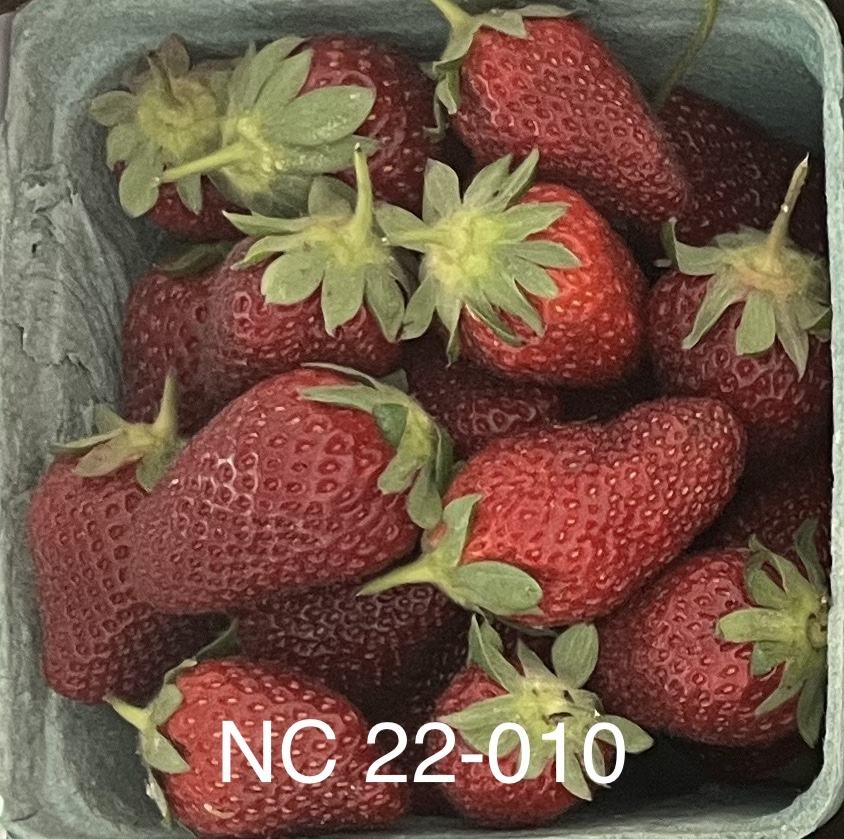
NC 22-010
Although NC 22-010 was not included in the 2026 replicated trial (we were unable to propagate plants), it remains one of the most exciting selections because of its exceptional eating quality. In 2025, it produced 17,597 lb/A total yield and 13,624 lb/A marketable yield (157% and 151% of 'Camarosa') with an average berry weight of 18.8 g. More importantly, it consistently ranks among the best selections for flavor and also carries the marker (Np2) for NeoP resistance.
Looking Ahead
Following Dr. Gina Fernandez's retirement on August 1, 2026, Dr. Mark Hoffmann and Ian Mellon will oversee the strawberry breeding program for the foreseeable future. Dr. Fernandez will remain involved in an emeritus capacity during the transition, helping ensure continuity of the program while supporting the evaluation of advanced selections and the development of future cultivars for North Carolina growers.