Optimize strawberry fertility with plant tissue testing
(pdf version: Strawberry tissue testing news release 2015)
Article by Kristin Hicks, Plant/Waste/Solution/Media Section chief, NCDA&CS Agronomic Services Division, 919-733-2655 (this article was first submitted on 2/23/15 - my sincere apologies for not getting this posted sooner!)
RALEIGH – Commercial strawberry production requires intensive and precise fertilization. The best way to decide how much fertilizer to apply is to collect leaf and petiole samples and have them tested for nutrient levels. The Agronomic Division of the N.C. Department of Agriculture and Consumer Services recommends collecting the first tissue samples when plants begin to flower and continuing to do so every two weeks throughout flowering and fruiting (approximately March 1 – May 30 in North Carolina).
The NCDA&CS laboratory measures actual concentrations of essential nutrients within the plant and compares them to established target concentrations for healthy strawberries. By monitoring nutrient levels and adjusting fertilization accordingly, growers can easily optimize crop growth and fruit quality. For strawberry tissue samples, both leaves and petioles are collected and submitted. Analysis of leaflets can reveal nutrient imbalances within the plant. Analysis of petioles indicates the amount of soil nitrogen currently available for crop growth and development, and serves as the basis for the nitrogen rate recommendation.
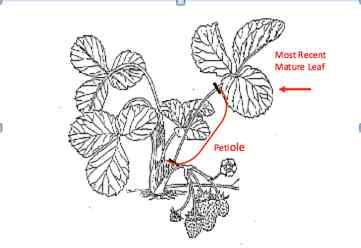
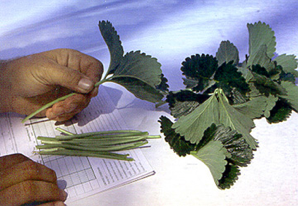
To collect a tissue sample from strawberry, select most recently mature, trifoliate leaves (MRMLs). Those leaves are full-sized and green and consist of one petiole (leaf stalk) with three leaflets. MRMLs are usually located three to five leaves back from the growing point. When MRMLs are being collected, it is very important to detach the petiole from the leaflets immediately. This action halts nutrient transfer between the two plant parts, which are analyzed separately.